Apr
18
2024
Our April speaker will be horticulturalist and garden writer, Nina Koziol. In her presentation, The Elegant Edible Garden, Nina will introduce us to the portager (pow tuh jay.). The potager is an elegant, productive kitchen garden—large or small—that provides seasonal vegetables, berries, and cutting flowers. Discover the elements that make attractive, functional layouts for your home, provide a wonderful harvest, and attract pollinators.
Meeting Location: St Andrew Lutheran Church (NE Corner of Prince Crossing & Geneva Road.)
Meeting Time:
- 6:45PM Arrive & Mingle
- 7:00PM Business Meeting
- 7:15PM Program
Apr
18
2024
 By Christina Covarrubias
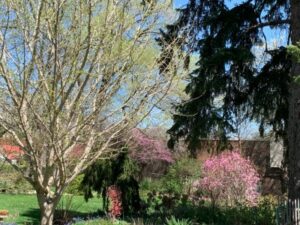
West Chicago Garden Club gardeners returned to the garden at the Kruse House museum property just last week and will meet every Wednesday from 9-11am weather permitting.
Gardening began just in time to inhale all the beauty of spring. Literally, at every turn in the garden there is a bright spot of color from the flowering barrenwort along the sidewalk, tulips dotting the landscape, Virginia bluebells, pink and purple lungwort, hot pink pigsqueak, a showstopper of a magnolia tree to blankets of violet-hued grape hyacinths that are children, grandchildren and great grandchild (probably) of the original ones planted by the Kruse family. A picture will not do it justice to represent how lovely the garden is in spring.
Ephemeral bulbs are not the only thing of interest in the garden. There are several unique species of trees including ginkgo, dogwood, London planetree, an original pear tree, and even a once-thought-extinct Dawn Redwood.
Just a note, from the Metasequoia genus native to China, a forester rediscovered Dawn Redwoods in one single Chinese region during the 1940’s. This led to seed collection and distribution around the world. The deciduous Dawn Redwood species sets itself apart from the other two redwoods species (Great Sequoia and Coast Redwood) by changing color to a rusty orange in the fall and then dropping its leaves. Such a treasure to have in this garden!
If you find yourself driving down Main Street at any time you should pull in the driveway and take a short (or long!) stroll around the garden.
Mar
21
2024
Can’t wait to start planning your spring garden?
In her presentation, “Best Plants for 2024,” our March speaker, Kim Hartmann, will show us what is new in trees, shrubs, annuals, perennials, roses, vegetables, and herbs.
With the many weather extremes we have had in recent years and the challenges of insect pests and diseases, it is helpful to learn about new varieties that are more tolerant and resistant while producing beautiful and vigorous plants.
Meeting Location: St Andrew Lutheran Church (NE Corner of Prince Crossing & Geneva Road.)
Meeting Time:
- 6:45PM Arrive & Mingle
- 7:00PM Business Meeting
- 7:15PM Program
 - Membership